The Exam That Makes MIT Look Easy: A Guide to the IIT-JEE for American Families
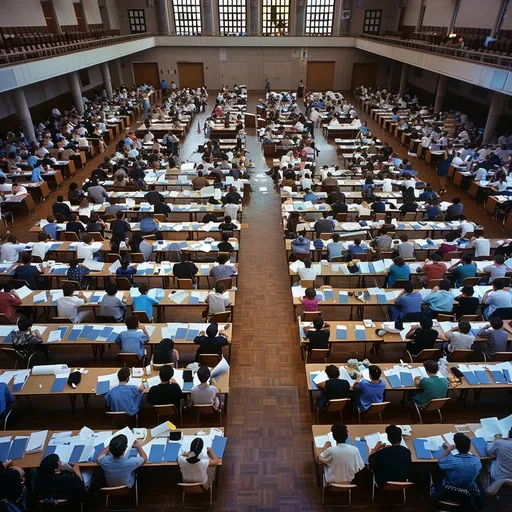
Photo: students taking difficult exam in large lecture hall, via images.stockcake.com
Ask a high-achieving American student about the hardest academic hurdle they can imagine, and they will likely point to MIT admissions — an institution that accepts roughly 4% of applicants — or perhaps the USA Mathematical Olympiad, taken by only a few hundred students each year. Then ask them about the Joint Entrance Examination, or JEE, administered in India, and most will have never heard of a test that makes both of those challenges look, statistically at least, far more forgiving.
What Exactly Is the IIT-JEE?
The IIT-JEE is the sole gateway to the Indian Institutes of Technology, a federation of 23 public engineering universities that function as the crown jewels of Indian higher education. The IITs — campuses in Mumbai, Delhi, Chennai, Kanpur, Kharagpur, and beyond — have produced CEOs of Google, Microsoft, and Adobe, along with a remarkable share of the faculty at America's top engineering departments.
The examination itself unfolds in two stages. The JEE Main, held multiple times per year, screens candidates and qualifies them for the JEE Advanced, the true filter. Only around 250,000 students earn the right to sit for Advanced, and from that pool, roughly 17,000 to 18,000 seats are available across all IIT campuses combined. Out of well over a million total candidates who begin the journey, the final acceptance rate hovers near one-half of one percent.
Putting the Numbers in an American Context
Consider the comparisons. Harvard's overall acceptance rate, famously brutal, sits around 3–4%. MIT accepts a similar share. The IIT-JEE Advanced, by contrast, admits fewer than 1 in 100 of its already pre-filtered candidates — and unlike American admissions, there are no essays, no extracurriculars, no legacy preferences, and no holistic review. The exam is purely a test of physics, chemistry, and mathematics, graded with unforgiving precision.
American olympiad students will recognize the flavor of the questions. JEE Advanced problems frequently demand the creativity of Olympiad mathematics combined with the speed of a standardized test. A single problem may require calculus, conceptual physics reasoning, and multi-step algebraic manipulation within a two-minute solving window. The syllabus itself covers material that many US students do not encounter until sophomore year of college.
Why Are American Students Paying Attention?
Several converging trends explain the growing American curiosity about the JEE.
First, the global technology economy has made IIT alumni among the most sought-after engineering talent in Silicon Valley and on Wall Street. Second, families with roots in the Indian diaspora — a community numbering over four million in the United States — increasingly want their children to understand, and sometimes attempt, this rite of passage. Third, there is a broader hunger among elite students for objective benchmarks. When everyone in a honors cohort has a 4.0 GPA, an exam where raw analytical ability is the only currency holds obvious appeal.
What Preparation Actually Looks Like
Serious JEE preparation typically spans two to three years, most commonly during what Americans would call grades 9 through 12. Students routinely solve tens of thousands of practice problems, take weekly mock examinations under strict timing, and study from texts like Irodov's Problems in General Physics — a book that circulates in American university physics lounges as a curiosity.
This is where structured coaching matters. At Bansal IIT-JEE Academy, we built our methodology on a simple observation: talent is common, but disciplined problem-solving under pressure is rare. Our programs emphasize conceptual depth before speed, weekly performance analytics shared with parents, and mock exams calibrated to the exact difficulty curve of recent JEE Advanced papers. Students preparing from the United States can pursue this pathway remotely, and many American-based aspirants of Indian origin now blend their US coursework with JEE-focused study.
What American Parents Should Know
For parents weighing this path, a few realities deserve emphasis.
The timeline is long. Unlike the SAT, which can be prepped in months, the JEE rewards sustained multi-year commitment. Starting early matters enormously.
The competition is absolute. There is no rounding, no subjectivity, and no alternate pathway. A student ranks where they rank.
The payoff is real, but so is the alternative. An IIT degree opens doors globally, yet students who prepare seriously for the JEE and then attend MIT, Georgia Tech, or UC Berkeley have lost nothing — the preparation itself produces mathematical maturity that transfers directly to AP Calculus, physics olympiads, and college entrance exams.
The Takeaway
The IIT-JEE is not for every student, and it should not be treated as a replacement for American college admissions. But for a particular kind of learner — one who finds standard curricula unchallenging and wants to test themselves against the sharpest young minds on the planet — it represents something rare: an examination with no shortcuts, no noise, and no ceiling on how good you can become.
That is a challenge worth understanding, wherever you happen to live.