The $200,000 Decision: Why Some Indian American Families Are Choosing IIT Bombay Over Ivy League Offers
The acceptance letter sat on the kitchen table in a Fremont, California home — an offer from a well-ranked private university with a tuition bill approaching $70,000 per year. Next to it was a very different document: confirmation of a qualifying rank in the JEE Advanced examination, the gateway to India's Indian Institutes of Technology. The family chose Mumbai over Massachusetts.
Stories like this one are no longer outliers. Across Indian American communities in the Bay Area, New Jersey, Texas, and the Chicago suburbs, a quiet but measurable shift is underway. Students who would be competitive applicants at top American universities are instead preparing for one of the most selective entrance examinations on Earth — and choosing to take their undergraduate degree in India.
The Numbers Behind the Choice
The financial comparison is stark. A four-year degree at a private US university routinely exceeds $280,000 once tuition, housing, and living expenses are included, and even flagship state schools can cost an out-of-state family $200,000 or more. An undergraduate seat at an IIT, by contrast, costs a fraction of that figure. Annual tuition at an IIT has historically been capped at levels that would amount to less than a single semester's fees at many American private colleges. Even accounting for travel and living costs, the total investment is dramatically lower.
For families that have spent decades saving for college, the arithmetic alone invites a second look. But cost is only part of the equation.
Career Return on Investment
The deeper argument is about outcomes. IIT alumni occupy leadership positions across global technology, finance, and consulting — CEOs of major multinationals, founders of prominent Silicon Valley companies, and partners at leading investment firms. Recruiters from Google, Microsoft, Goldman Sachs, and Jane Street actively recruit on IIT campuses, and placement season at the top IITs draws offers that rival starting salaries in the United States.
A graduate holding an IIT degree and US citizenship or permanent residency occupies a particularly advantageous position: the credential carries immense weight in both the American and Indian markets, and the graduate faces none of the visa friction that complicates the reverse path for international students in the US. For a US-based student, the degree functions as a globally recognized signal without the debt burden that typically accompanies it.
The Obstacle: One of the Hardest Exams in the World
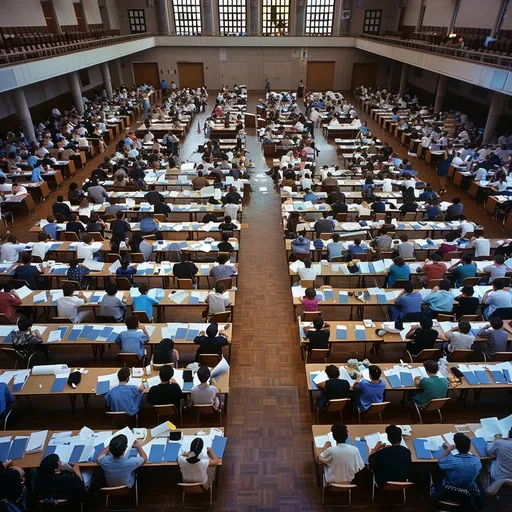
None of this comes free. The JEE Advanced examination admits roughly the top tier of an applicant pool exceeding a million candidates, and the preparation demanded is unlike anything American students encounter. Where a strong US applicant demonstrates breadth — activities, essays, service — the JEE rewards depth in physics, chemistry, and mathematics at a level that many describe as closer to university coursework than high school material.
This is where structured preparation becomes decisive. US-based students cannot rely on the ecosystem of coaching that surrounds the exam in Kota, Delhi, and other Indian preparation hubs. Families that succeed typically commit to a disciplined, multi-year preparation plan beginning in the ninth or tenth grade, pairing rigorous study with the demands of an American school schedule. The students who clear the bar are, almost without exception, those who treated preparation as a sustained project rather than a senior-year sprint.
NRI candidates also benefit from dedicated admission channels, including seats reserved for persons of Indian origin and foreign nationals, which follow a somewhat different — though still highly competitive — selection process. Understanding these pathways early is essential, as eligibility criteria and deadlines diverge significantly from the standard route.
Who Should Consider This Path
The IIT route is not for every student. It suits those with genuine passion for mathematics and the physical sciences, the discipline to prepare against extraordinary competition, and families comfortable with an unconventional college story. Students who thrive on breadth, campus culture variety, or the liberal arts may find American universities a better fit.
But for the right student — the one who reads physics problems for enjoyment and views a hundred thousand competitors as motivation rather than deterrent — the case is compelling. A world-class technical education, a globally admired credential, a network spanning two continents, and four years of college costs that would not cover a single year in Boston.
The kitchen table in Fremont tells the story. Increasingly, American families are doing the math and reaching the same conclusion.